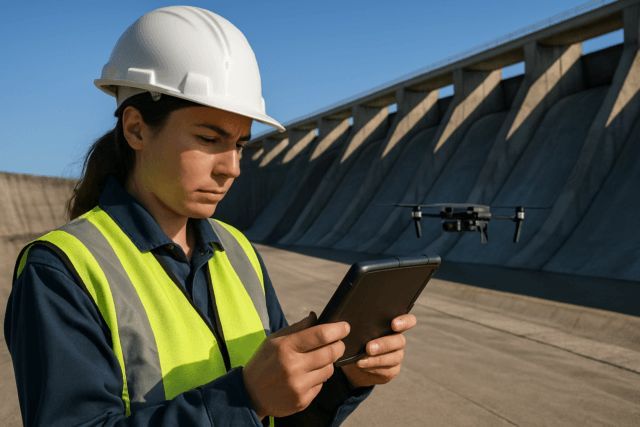

Retaining walls, critical for supporting soil and preventing erosion, demand rigorous and regular inspections to ensure their structural integrity. Traditional inspection methods often involve hazardous manual assessments, requiring scaffolding, ladders, or rope access in challenging terrain. However, the advent of Unmanned Aerial Systems (UAS), commonly known as drones, has revolutionized this field, offering a safer, more efficient, and highly accurate approach to retaining wall inspection and surveying.
Drone surveys for retaining walls leverage advanced aerial technology to capture comprehensive visual and spatial data, transforming how potential issues are identified, monitored, and addressed. This guide delves into the methodology, essential equipment, and benefits of integrating drones into your retaining wall inspection workflow.
The Undeniable Benefits of Drone Inspections for Retaining Walls
Deploying drones for retaining wall inspections offers significant advantages over conventional techniques:
- Enhanced Safety: Drones eliminate the need for personnel to access dangerous, hard-to-reach areas, such as steep slopes, high elevations, or unstable ground, drastically reducing the risk of accidents and injuries.
- Increased Efficiency and Speed: Drones can cover large or complex retaining wall structures rapidly, collecting vast amounts of data in a fraction of the time it would take manual teams. This leads to faster identification and repair of problems, minimizing downtime.
- Cost Savings: By reducing the need for expensive equipment like scaffolding, lifts, or specialized rope access teams, and minimizing labor hours, drone inspections can be significantly more cost-effective.
- Superior Data Quality and Detail: Equipped with high-resolution cameras and advanced sensors, drones capture detailed imagery and precise spatial data, often revealing subtle defects that might be missed by the human eye.
- Greater Accessibility: Drones can easily reach and inspect areas that are difficult or impossible for human inspectors to access, providing a complete picture of the wall’s condition.
- Comprehensive Documentation and Monitoring: Drone-collected data can be used to create detailed 2D and 3D models, orthomosaics, and point clouds, providing a verifiable, time-stamped record for ongoing monitoring, change detection, and informed decision-making regarding maintenance and repairs.
Essential Equipment and Technology for Retaining Wall Surveys
A successful drone survey relies on selecting the right UAS and its integrated payload.
Choosing the Right Drone Platform
Multi-rotor drones (e.g., quadcopters, hexacopters) are generally preferred for retaining wall inspections due to their ability to hover, maintain stability in tight spaces, and maneuver with precision along vertical surfaces. Drones like the DJI M300 RTK, when paired with appropriate sensors, have proven effective in collecting measurements in challenging conditions. Key considerations for the drone platform include:
- Flight Time and Range: Longer battery life is crucial for covering extensive wall sections without frequent landings.
- Stability: The drone should be able to maintain stable flight in varying wind conditions, especially when flying close to vertical structures.
- Payload Capacity: Ensure the drone can comfortably carry the necessary cameras and sensors without compromising flight performance.
Advanced Sensors and Cameras
The choice of sensors dictates the type and quality of data collected:
- High-Resolution RGB Cameras: These are standard for visual inspections, capturing detailed images and video of surface conditions. For structural inspections, 4K resolution or higher is often required for effective defect identification. A 3-axis gimbal is essential for maintaining camera stability and capturing accurate, steady data.
- LiDAR (Light Detection and Ranging): LiDAR sensors are invaluable for creating highly accurate 3D point clouds of the retaining wall and its surrounding terrain, especially in areas with vegetation that might obscure visual data. LiDAR can penetrate light foliage, providing a clearer representation of the wall’s structure and any deformations.
- Thermal Imaging Cameras: These can detect hidden moisture infiltration, insulation deficiencies, or temperature anomalies that might indicate structural issues not visible to the naked eye.
- Ground Penetrating Radar (GPR): Drone-based GPR, such as the RadSys Zond Aero LF 300, can provide non-destructive quality control for retaining wall construction by checking the depth of structural elements, even in post-construction stages. It uncovers hidden details and subsurface as-built compliance.
Pre-Flight Planning and Preparation
Thorough planning is the bedrock of a successful and safe drone survey.
Define Inspection Goals and Site Assessment
Clearly outline what you aim to achieve with the inspection. Are you looking for cracks, deformation, drainage issues, or overall structural integrity? Conduct a detailed site assessment to identify potential hazards, obstacles (e.g., trees, power lines, buildings), and areas of interest around the retaining wall. Understanding the terrain, especially difficult access points or steep vegetation, is crucial.
Regulatory Compliance and Permissions
Before any flight, ensure you have all necessary permits, licenses, and authorizations. This includes adhering to aviation authority regulations (e.g., FAA in the US) regarding airspace restrictions, commercial drone operations, and maintaining visual line of sight (VLOS). Property owner consent is also mandatory.
Crafting a Detailed Flight Plan
A systematic flight plan ensures complete coverage and consistent data quality.
- Automated Mapping Software: Utilize flight planning software to define the drone’s flight path, altitude, and speed. These tools can assist in maintaining necessary overlap and consistency, especially in uneven terrain.
- Altitude and Overlap: Choose an altitude that balances safety with image quality. Flying closer provides higher resolution, but a higher altitude covers more area faster. For mapping, a high overlap (70% or more, both forward and sideward) is recommended to ensure robust 3D model generation. For detailed inspection, 20-30% overlap might suffice if the goal is not a full 3D model.
- Ground Control Points (GCPs): For surveys requiring high accuracy and georeferencing, strategically place GCPs with high contrast. These points are surveyed using traditional methods and used to anchor the drone data to real-world coordinates, improving the precision of 3D models and measurements.
- Weather Conditions: Monitor weather conditions closely. Wind, rain, or extreme temperatures can affect drone performance and data quality. Adjust or postpone flights if necessary.
Data Capture Techniques
Executing the flight plan requires careful attention to detail to ensure high-quality data collection.
Systematic Flight Paths
For retaining walls, a systematic flight path along the face of the wall is crucial. This may involve flying in parallel lines at a consistent distance from the wall, or following its contours. For comprehensive site analysis, broader aerial mapping may also be conducted. Using automated flight modes helps ensure consistency and repeatability, which is vital for monitoring changes over time.
Optimizing Camera Settings
Adjust camera settings such as exposure, focus, resolution, and white balance to capture clear and detailed images. Ensure the camera angle is appropriate for capturing the entire wall surface without distortion. For specific defect identification, closer flights might be necessary to achieve a higher Ground Sampling Distance (GSD), which refers to the real-world size of one pixel in an image.
Post-Processing and Analysis
Once data is collected, specialized software transforms raw images and sensor readings into actionable insights.
Photogrammetry vs. LiDAR Data Processing
- Photogrammetry: For RGB images, photogrammetry software (e.g., Pix4D, DroneDeploy, Agisoft Metashape, Site Scan for ArcGIS) processes overlapping images to create 2D orthomosaics, 3D models, and point clouds. These visual models are excellent for identifying surface defects like cracks, spalling, and misalignments.
- LiDAR Processing: LiDAR data generates highly accurate 3D point clouds directly, which are then processed using specialized software (e.g., Global Mapper, Leica Register 360) to analyze terrain features, identify deformations, and create detailed digital elevation models (DEMs).
Defect Identification and Analysis
Inspect the generated 3D models, point clouds, and orthomosaics for various retaining wall issues. Software tools often allow for precise measurements, annotations, and comparisons with historical data or design plans. This enables the detection of:
- Cracks and spalls.
- Bulges or distortion in the wall facing.
- Misaligned joints or elements.
- Evidence of settlement or structural deformation, such as leaning or bowing.
- Drainage issues (e.g., blocked weep holes, excessive ponding).
- Vegetation encroachment or root penetration.
Reporting and Archiving
Generate comprehensive reports from the analyzed data, including annotated images, 3D models, and detailed measurements. These reports provide critical information for engineers, maintenance teams, and stakeholders, informing decisions about necessary repairs or ongoing monitoring. Storing this data centrally allows for easy access and comparison during future inspections.
The Future of Retaining Wall Inspection
The integration of drones with advanced analytics, including artificial intelligence (AI) and machine learning (ML), is poised to further enhance retaining wall inspections. These technologies can analyze vast datasets to identify patterns, predict potential failures, and create predictive models for the life cycle of retaining walls. Drone-based GPR solutions are also showing immense promise for non-destructive quality control and subsurface analysis.
By embracing drone survey technology, professionals in engineering, construction, and infrastructure management can ensure safer, more efficient, and highly accurate inspections, ultimately contributing to the longevity and stability of critical retaining wall structures.