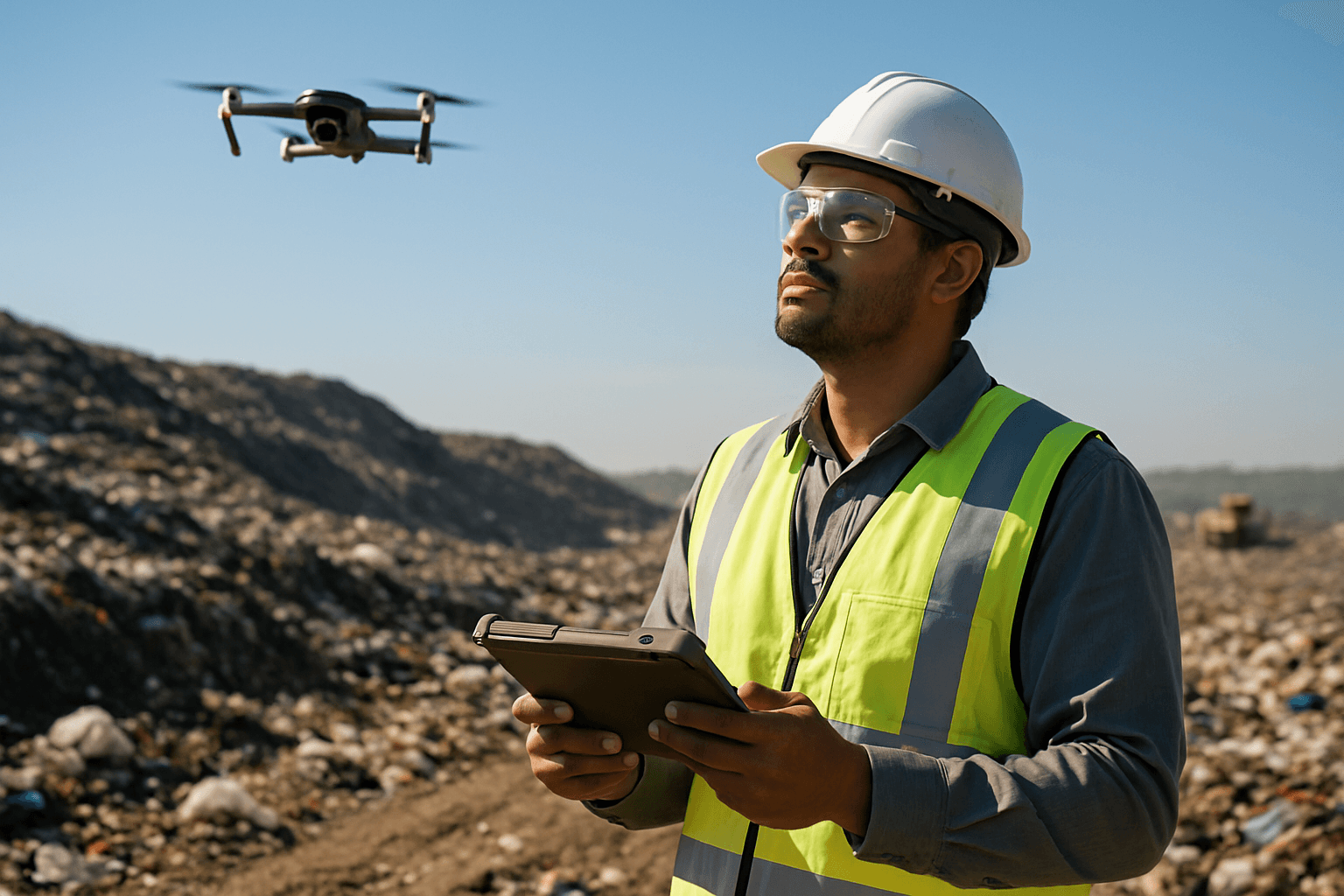
Landfills are significant contributors to global methane emissions, with municipal solid waste (MSW) landfills in the U.S. alone releasing an estimated 4.5 million metric tons of methane annually, making them the third-largest source of methane emissions in the country. This potent greenhouse gas has a warming effect 28 times greater than carbon dioxide over a 20-year timescale. Traditional methods for monitoring landfill gas (LFG) are often labor-intensive, time-consuming, costly, and expose workers to hazardous conditions and uneven terrain. Fortunately, Unmanned Aerial Systems (UAS), or drones, are revolutionizing this critical environmental task, offering a safer, faster, and more accurate approach to detecting, localizing, and quantifying methane emissions.
This guide delves into how to conduct a drone survey for landfill gas monitoring, outlining the essential steps, technologies, benefits, and considerations for effective implementation.
The Advantages of Drone-Based Landfill Gas Monitoring
Integrating drones into landfill operations offers a multitude of benefits over conventional methods:
Enhanced Safety and Efficiency
Traditional surface emissions monitoring (SEM) requires technicians to walk extensive serpentine paths across landfill surfaces, often exceeding 20 miles for a 100-acre site over several days, placing them in hazardous environments with potential exposure to toxic gases and unstable waste. Drones eliminate the need for human presence in these dangerous areas, significantly improving worker safety. They can also cover large areas much faster; a 200-acre site can be surveyed in approximately 4 hours, with only about 1 hour of actual flight time, compared to an entire day or several days using traditional methods.
Superior Data Quality and Precision
Drones can capture high-resolution imagery and precise spatial data, enabling more accurate identification and localization of methane leaks. This detailed data supports better decision-making for methane monitoring and risk assessment.
Cost-Effectiveness
While the initial investment in drone technology exists, the long-term cost savings are substantial. Drones reduce operational costs by requiring fewer personnel and minimizing reliance on expensive ground-based equipment or manned aircraft.
Proactive Environmental Management
Early and accurate detection of methane leaks allows landfill operators to take timely action, preventing the escalation of environmental issues, reducing greenhouse gas emissions, and ensuring compliance with stringent environmental regulations.
Key Technologies for Drone-Based Landfill Gas Monitoring
Effective drone surveys for landfill gas monitoring rely on specialized payloads and advanced sensor technologies:
Methane Detection Payloads
These are the core of landfill gas monitoring drones. Several primary sensor technologies are used:
- Tunable Diode Laser Absorption Spectroscopy (TDLAS) Sensors: TDLAS sensors emit a laser light that reflects off the ground and is captured by the sensor. If methane is present along the laser path, the light is partially absorbed, allowing the sensor to calculate gas concentration in parts per million per meter (ppm*m). These systems can detect methane from distances of 10 to 80 meters with high sensitivity (0-100,000 ppm x m) and can detect 500 ppm reliably from at least 40m, meeting specific regulatory criteria. The optimal flight altitude for TDLAS sensors is typically not exceeding 15 meters above ground level, with a UAV speed between 1 and 2 m/s.
- Drone Surface Emissions Monitoring (DSEM) Systems: An EPA-approved alternative to Method 21, DSEM systems use a multirotor UAS with an umbilical that features a weighted air nozzle. This nozzle is kept 5-10 centimeters (2-4 inches) from the landfill surface, allowing direct measurement of methane concentrations at the point of emission. This method directly identifies specific leak locations and minimizes environmental interference, leading to more accurate data.
- Optical Gas Imaging (OGI) Cameras: OGI cameras use infrared technology to visualize gases that are invisible to the naked eye. They are particularly effective for detecting hydrocarbon-based gases like methane and can quickly visualize gas plumes and leaks, even from a distance. OGI surveys are often part of regulatory compliance for identifying and addressing methane leaks.
Thermal Imaging Cameras
Thermal cameras detect variations in surface temperatures. Decomposing waste generates heat, and landfill gas, warmed by this exothermic process, can manifest as thermal anomalies on the surface. These cameras are crucial for identifying potential “hotspots” that may indicate subsurface fires or significant methane emissions. However, studies indicate that a minimum methane emission of around 150 g CH4 m-2 d-1 from an area greater than 1 m2 is necessary for a thermal infrared camera to reliably identify a hotspot, and temperature differences observed can be subtle (0.7°C to 1.2°C).
Hyperspectral Imaging Sensors
Hyperspectral cameras capture hundreds of narrow spectral bands, providing a detailed “fingerprint” of methane as it absorbs infrared light. This technology offers enhanced spectral sensitivity, allowing for the detection of methane even at lower concentrations and the differentiation of methane from other hydrocarbons. While satellite-based hyperspectral imagers are used for global methane monitoring, drone-mounted versions can provide high-resolution data for specific landfill sites.
Steps to Conduct a Drone Survey for Landfill Gas Monitoring
Executing a successful drone survey for landfill gas monitoring involves careful planning, execution, and data analysis.
1. Pre-Flight Planning and Preparation
- Define Objectives: Clearly outline what you aim to achieve (e.g., leak detection, quantification, hotspot identification, regulatory compliance).
- Site Assessment: Understand the landfill’s topography, size, vegetation cover, and potential obstacles. Landfill terrain can be uneven, and ground cover like tall grass can affect altitude measurements, making precision challenging.
- Regulatory Compliance: Familiarize yourself with local, national, and international regulations for drone operation and landfill emissions monitoring. In the U.S., the EPA requires regular monitoring of landfill methane emissions according to Method 21, and specific alternative methods like OTM-51 (used by Sniffer Robotics) are approved for UAS applications. Ensure you have the necessary certifications and permissions for drone operation.
- Equipment Selection: Choose the appropriate drone platform (typically multirotor for stability and maneuverability) and sensor payloads based on your objectives (e.g., TDLAS, DSEM, OGI, thermal, or hyperspectral).
- Flight Planning Software: Utilize specialized software (e.g., UgCS) to create automated flight paths. This allows for systematic coverage, maintaining a constant height above ground level (AGL), which is crucial for data consistency, especially with path-integrated sensors. The drone should be controllable by a remote operator to deviate from automated plans if visual observations (like distressed vegetation or cracks) indicate potential leaks.
- Battery Management: Drone flight times are limited (often around 30 minutes per battery set). Plan for sufficient batteries and on-site recharging capabilities, which can be a challenge in remote locations.
- Calibration: Calibrate methane detection payloads using zero gas (air with less than 10 ppmv methane) and methane calibration gas (approximately 500 ppm above background) as required by regulatory standards.
2. Drone Operation and Data Acquisition
- Weather Conditions: Conduct surveys under optimal weather conditions. Wind speed and direction can significantly affect gas plume dispersion and detection. Sunny days may produce higher methane background levels than cloudy ones.
- Consistent Flight Parameters: Maintain a constant flight altitude (e.g., 5-15 meters AGL for TDLAS or DSEM systems) and speed to ensure consistent data collection.
- Real-time Monitoring: The drone system should transmit geolocated methane readings to the operator in real-time. This allows immediate identification of “hot spots” where methane concentrations exceed a predefined threshold (e.g., 500 ppm above background for Method 21 compliance).
- Visual Inspection: Utilize the drone’s gimbaled camera for visual observations during flight, looking for indicators of LFG emissions like distressed vegetation, cracks, or seeps in the landfill cover. These visual cues can prompt the operator to pause or deviate from the automated flight plan for closer inspection.
- Data Logging: Ensure the drone’s data acquisition system records timestamped drone position (GPS coordinates with at least ±2 meters accuracy) and methane concentration at a high frequency.
3. Post-Processing and Data Analysis
- Georeferenced Mapping: Process the collected data to create detailed, georeferenced thermal and gas maps of the landfill site.
- Hotspot Identification: Analyze the maps to identify areas with elevated methane concentrations (“hotspots”) or abnormal thermal signatures. These maps help assess and prioritize areas needing immediate attention.
- Quantification and Reporting: For compliance, quantify methane emissions from identified leak sources. DSEM systems, for example, have algorithms for quantifying emissions from their data. Document all findings, including the precise location of leaks (typically marked with flags and recorded with GPS) and concentrations.
- Integration with Other Data: Combine drone data with other landfill management information, such as topographic maps, waste composition data, and compaction rates, to gain a comprehensive understanding of site conditions and inform operational decisions.
Challenges and Considerations
While drone surveys offer significant advantages, several challenges must be addressed:
- Battery Life and Logistics: Limited flight time necessitates careful planning for battery swaps and on-site charging, especially for large landfills or remote locations.
- Environmental Factors: Wind, temperature, and atmospheric pressure can influence methane dispersion and sensor readings, requiring careful consideration during data interpretation.
- Sensor Limitations: The accuracy and detection limits vary by sensor type. For instance, path-integrated concentration measurements (ppm-m) from TDLAS are sensitive to altitude, and their interpretation does not directly correlate with volumetric methane concentration close to or away from the source. Thermal imaging may only detect larger, more concentrated emissions under specific conditions.
- Data Interpretation: Analyzing and interpreting the vast amounts of data collected by drones requires specialized software and expertise.
- Regulatory Evolution: While the EPA has approved specific drone methods like OTM-51, regulatory frameworks are still evolving, and new technologies may require validation for compliance.
The Future of Landfill Gas Monitoring
Drone technology is continuously advancing, with ongoing research focusing on improved sensor development, enhanced data analytics, and artificial intelligence integration for automated leak detection and quantification. Multi-drone systems working in sync can cover larger areas more quickly and thoroughly. These advancements promise even greater efficiency, accuracy, and safety, solidifying the role of UAS as an indispensable tool in proactive landfill gas monitoring and environmental stewardship.