
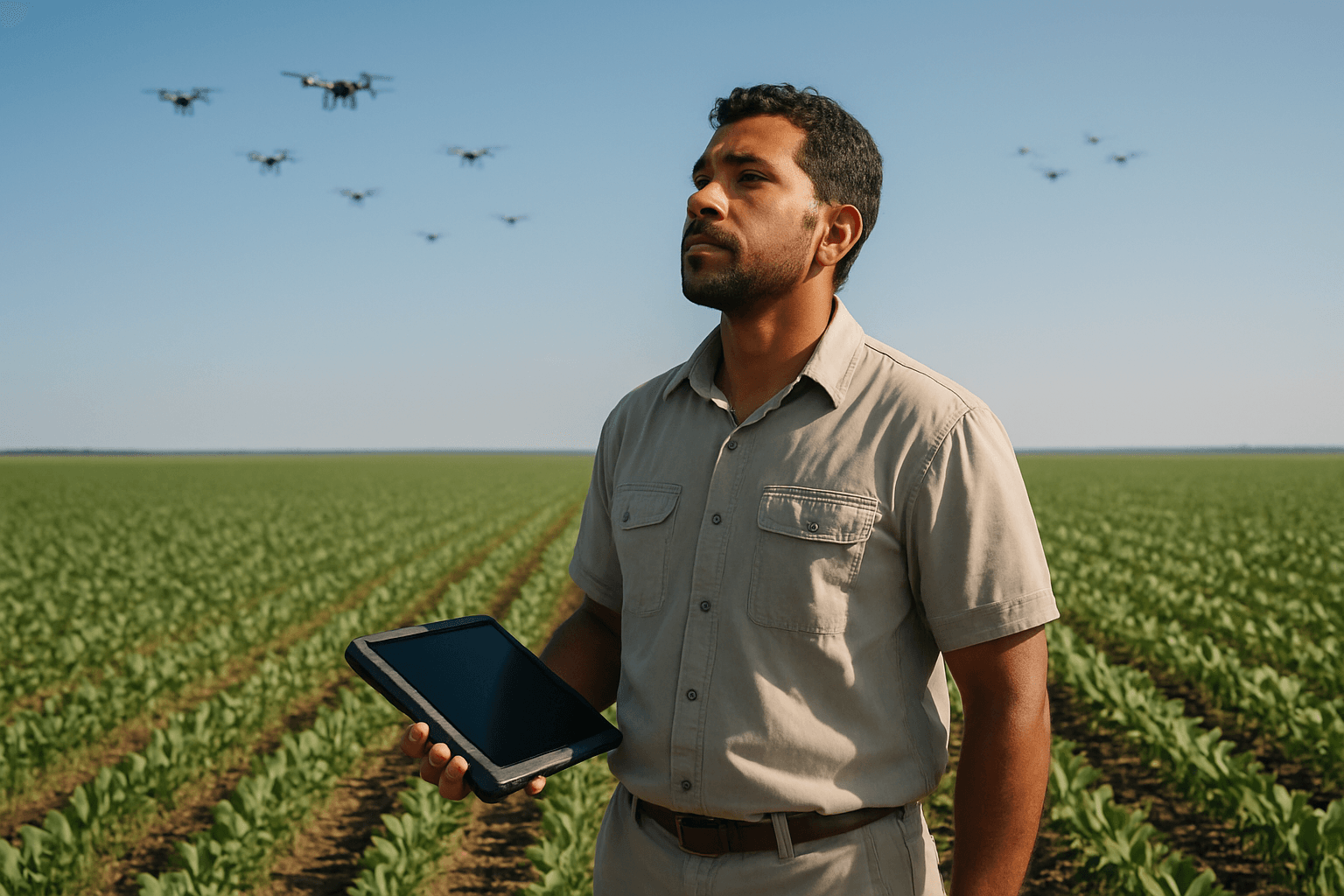
Modern agriculture faces the monumental task of feeding a growing global population while grappling with resource scarcity, climate change, and labor shortages. Traditional farming methods, often labor-intensive and resource-demanding, struggle to keep pace with these challenges. Enter drone swarms: a revolutionary leap in precision agriculture that promises to transform large-scale farming by deploying multiple unmanned aerial vehicles (UAVs) in coordinated, intelligent systems. This technology is not merely an incremental improvement but a paradigm shift, offering unparalleled efficiency, precision, and sustainability, fundamentally reshaping how we cultivate our food.
Understanding Drone Swarms in Agriculture
Drone swarms are collections of multiple unmanned aerial vehicles (UAVs) that communicate and work together as a single, cohesive unit to accomplish specific tasks. Unlike individual drones, which offer limited coverage and operational capacity, a swarm leverages collective intelligence and coordinated behavior to cover vast agricultural areas much more efficiently and rapidly. This “swarm intelligence” often mimics natural behaviors seen in insect colonies or flocks of birds, where individual units follow simple rules but collectively perform complex operations.
Advantages Over Single-Drone Operations
The benefits of utilizing drone swarms in large-scale agricultural operations are substantial when compared to deploying single drones:
- Dramatically Increased Coverage: Research indicates that drone swarms can achieve up to 800% increased coverage compared to single-drone operations, allowing farms exceeding 1,000 acres to be scanned in hours rather than days.
- Redundancy and Reliability: If one drone malfunctions or requires a battery change, the remaining units can automatically redistribute the workload, minimizing downtime by up to 90%.
- Sophisticated Data Collection: Multiple drones collecting data simultaneously enable multi-spectral analysis from different heights and angles, real-time comparative data gathering, and 3D terrain and crop modeling with centimeter-level accuracy. This also allows for instant cross-verification of detected anomalies.
- Efficiency in Task Execution: Swarms can split tasks by area or function, covering vast expanses exponentially faster than individual drones.
Key Applications of Drone Swarms in Precision Agriculture
The versatility of drone swarms allows for their application across numerous critical aspects of large-scale farming, enabling unprecedented levels of precision and responsiveness.
Advanced Crop Monitoring and Scouting
Drone swarms equipped with various sensors, including multispectral, hyperspectral, and thermal cameras, provide high-resolution, real-time data on crop health. These sensors can detect plant stress indicators such as canopy temperature, chlorophyll levels, and soil moisture long before symptoms are visible to the naked eye. This early detection is crucial for identifying nutrient deficiencies, water stress, and disease outbreaks, allowing farmers to intervene proactively.
- Real-time Insights: Swarms can rapidly survey thousands of acres, providing up-to-the-minute information on crop conditions, pest infestations, and irrigation needs.
- Detailed Analysis: By integrating data with machine learning models, farmers can optimize fertilizer use, irrigation schedules, and pest management, leading to healthier crops and improved yields.
- Weed Mapping: Drone swarms can precisely map the presence of weeds among crops, attracting each other to weed-infested areas for targeted inspection, similar to how bees forage for profitable flower patches.
Targeted Spraying and Input Application
One of the most impactful applications of drone swarms is in the precise application of fertilizers, pesticides, and herbicides.
- Reduced Chemical Use: Swarm systems enable targeted application of inputs, which can reduce fertilizer use by up to 30% and herbicide use by as much as 70% in precision weeding applications. This direct-to-plant intervention minimizes chemical runoff, reducing water pollution and preserving beneficial insect populations.
- Improved Efficiency: Drones can apply liquid fertilizers with 90-95% accuracy, ensuring more uniform and targeted nutrient distribution. A single drone operator, utilizing FAA exemptions, can now oversee a swarm of up to three large drones, significantly increasing productivity and covering up to 150 acres per hour.
- Accessibility to Difficult Terrain: Drones are particularly effective for spraying small, irregular-shaped fields or areas where topography or soil conditions make traditional ground sprayers impractical.
Precision Seeding and Planting
While still developing, drone swarms are also being explored for seeding operations. Companies are developing AI-directed drones capable of planting seeds, with some initiatives aiming to plant hundreds of thousands of seed pods per day for reforestation efforts, demonstrating the potential for agricultural planting.
Environmental Monitoring and Data Granularity
Beyond crop-specific tasks, drone swarms enhance environmental monitoring capabilities by providing granular data.
- Soil Analysis: Swarms can simultaneously map soil moisture, nutrient content, and plant-soil diversity at a centimeter-level resolution, aiding in preemptive soil remediation and halting erosion before visible loss.
- Biodiversity Conservation: The ecological data granularity offered by drone swarms provides the geospatial technology needed to conserve and manage biodiversity on a global scale.
Technological Underpinnings and Future Outlook
The effectiveness of drone swarms in agriculture relies heavily on advanced technological integration, particularly in artificial intelligence (AI), machine learning, and cloud computing.
AI and Cloud Computing for Coordinated Fleets
Modern agricultural swarms utilize edge computing capabilities, allowing drones to process critical data locally and make autonomous decisions without constant human intervention. AI-driven mission planning, based on historical field data, enables dynamic reallocation of resources and automated identification of priority zones for treatment. Machine learning systems within swarms continuously improve the identification of crop stressors, develop farm-specific treatment protocols, and optimize application rates based on historical outcomes.
Regulatory Landscape and Adoption
The regulatory environment is gradually adapting to support drone swarm technology. In the U.S., the Federal Aviation Administration (FAA) has begun granting exemptions that allow a single operator to oversee multiple drones simultaneously, specifically for agricultural spraying, boosting efficiency and making drone farming competitive with traditional methods. This paves the way for broader implementation of drone swarm technology in large-scale farming operations.
Challenges and Opportunities
Despite the immense potential, implementing drone swarms in agriculture presents challenges:
- Regulatory Hurdles: Navigating airspace regulations, privacy concerns, and safety considerations for widespread drone swarm deployment remains an ongoing effort.
- Initial Cost and Infrastructure: The initial investment in drone technology and the necessary infrastructure can be substantial, posing challenges for smaller farms.
- Data Management and Training: The vast amount of data generated by drone swarms requires efficient management and analysis, and farmers and operators need adequate training to effectively utilize and maintain these complex systems.
- Battery Life: Extending drone flight times and minimizing downtime for recharging or battery replacement is an ongoing technological challenge.
However, the future for drone swarms in agriculture is exceptionally promising. Continuous advancements in AI integration, battery technology, and sensor capabilities are expected to further enhance drone functionalities. As the market expands globally, drone swarms are poised to become essential tools for sustainable and efficient farming practices, providing precise data and enabling targeted operations that promise improved yields and resource management in the face of evolving agricultural needs and environmental challenges.