In the high-stakes world of Search and Rescue (SAR), every piece of information is critical, and its accuracy can mean the difference between life and death. Unmanned Aerial Systems (UAS), commonly known as drones, have become indispensable tools, offering unparalleled speed, versatility, and access to challenging terrains. However, the true potential of these aerial assets, particularly in gathering precise environmental data, hinges on a frequently overlooked but profoundly important practice: sensor calibration. Without rigorous calibration, the thermal signatures, chemical readings, or topographical maps generated by SAR drones can be misleading, compromising mission success and rescuer safety.
This article delves into the crucial role of drone sensor calibration, exploring why it is vital for accurate environmental data in SAR operations, the types of sensors involved, their specific calibration methods, and the ongoing innovations shaping the future of this critical discipline within aviation technology.
Why Sensor Calibration is Paramount for SAR Operations
Accurate environmental data is the bedrock of effective SAR missions. Drones equipped with a suite of advanced sensors can detect heat signatures, map inaccessible areas, and even identify hazardous gases, providing real-time situational awareness for rescue teams. However, the reliability of this data directly correlates with the calibration status of the drone’s sensors.
Uncalibrated or poorly calibrated sensors can lead to a cascade of errors:
- Inaccurate Target Localization: A thermal camera that isn’t properly calibrated might misinterpret temperature readings, causing rescuers to search in the wrong areas for a missing person, especially in low visibility conditions or at night. Errors can increase from ±0.5 °C in laboratory conditions to ±5 °C in unstable flight conditions for thermal cameras.
- Misleading Environmental Assessments: Gas sensors, for instance, can be affected by factors like humidity, leading to incorrect readings of hazardous substances. This could endanger rescue personnel entering a compromised environment.
- Distorted Mapping and Navigation: LiDAR and photogrammetry sensors rely on precise measurements for 3D mapping and obstacle avoidance. Without calibration, the resulting maps can be distorted, leading to navigational errors or even collisions in complex terrain.
- Reduced Operational Efficiency: Inaccurate data necessitates repeated flights or extensive post-processing corrections, wasting valuable time in time-sensitive SAR scenarios.
Proper calibration ensures that sensors provide consistent, reliable, and precise data across various missions and environmental conditions, thereby enhancing operational reliability and productivity.
Essential Environmental Sensors in SAR Drones
SAR drones leverage a diverse array of sensors to gather comprehensive environmental data. Each sensor type has specific applications and, consequently, unique calibration requirements.
Thermal Imaging Sensors
Thermal cameras are perhaps one of the most vital tools in SAR, capable of detecting heat signatures from individuals in darkness, smoke, fog, dense foliage, or under debris. They operate by capturing long-wave infrared radiation, visualizing heat emissions against cooler backgrounds.
Multispectral and Hyperspectral Cameras
These cameras capture data across dozens to hundreds of narrow wavelength bands, from visible to near-infrared. In environmental monitoring, they can detect vegetation stress, changes in soil composition, or even highlight plant stress, chlorophyll content, or invasive species intrusion, which can be critical in search efforts in vegetated areas.
LiDAR (Light Detection and Ranging)
LiDAR systems emit millions of laser pulses per second to create highly accurate 3D point clouds of the terrain, penetrating dense canopies to reveal ground topography and measure biomass. This is invaluable for mapping disaster zones, assessing structural damage, and navigating complex environments where traditional visual methods are insufficient. LiDAR also plays a crucial role in obstacle avoidance for drones.
Gas Detection Sensors
Equipped with technologies like Tunable Diode Laser Absorption Spectroscopy (TDLAS) or electrochemical sensor arrays, these drones can detect and quantify hazardous gases such as methane, CO₂, and volatile organic compounds (VOCs) at parts-per-billion levels. This is essential for assessing risks in post-disaster scenarios or industrial accidents.
Calibration Methods and Best Practices for SAR Drone Sensors
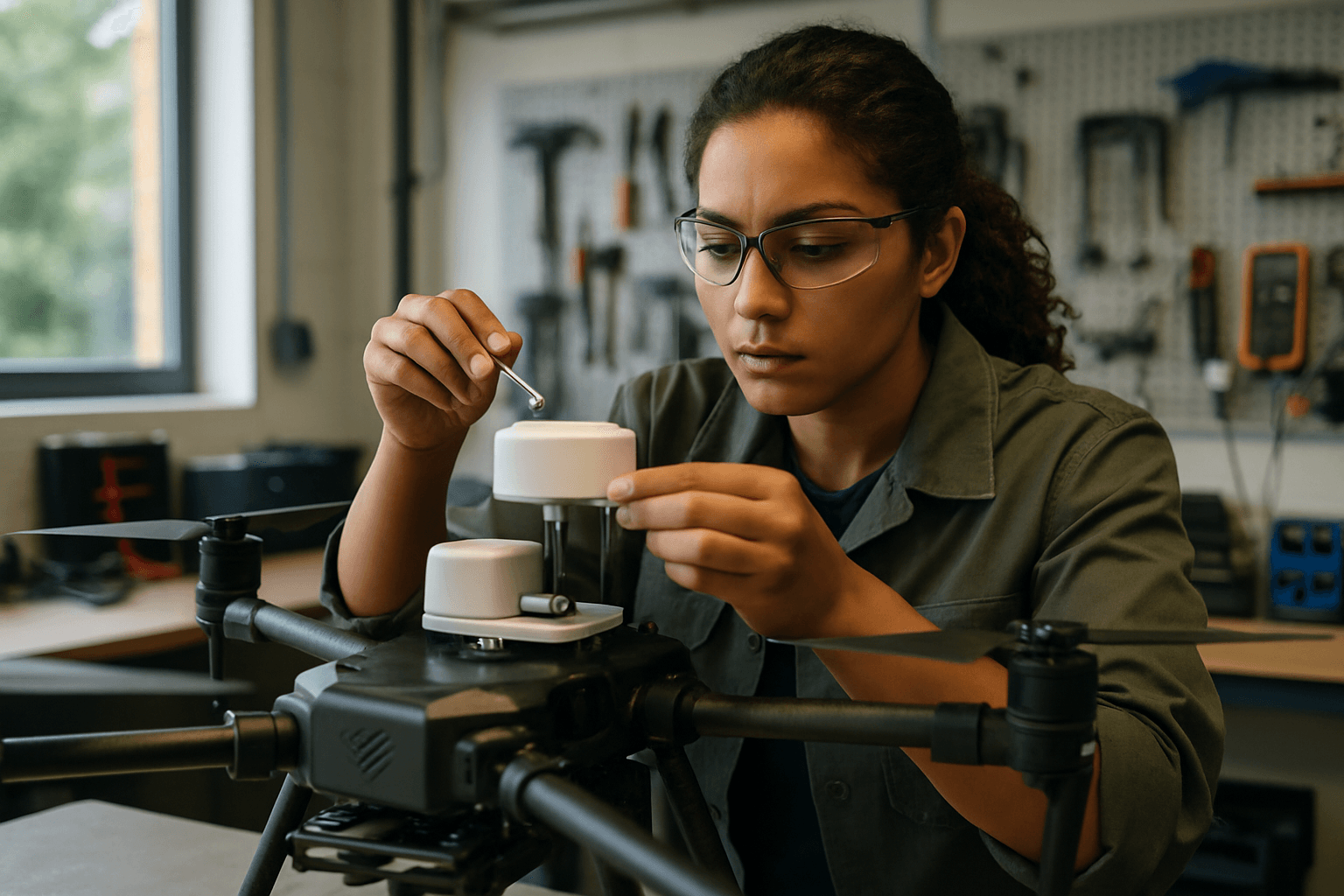
The calibration process involves aligning and fine-tuning a drone’s sensors to ensure accurate and reliable data collection. It corrects for hardware misalignments, sensor drift, and environmental factor discrepancies.
Thermal Camera Calibration
Thermal sensors require careful calibration to maintain accuracy, especially given their sensitivity to temperature fluctuations.
- Blackbody Sources: Laboratory calibration often involves using blackbody sources at known temperatures to ensure the sensor’s readings align with actual temperatures.
- External Heated Shutters: Some advanced systems incorporate external heated shutters as a calibration source, improving thermal measurements and producing more consistent, accurate temperature data during flight, even in varying ambient conditions.
- In-field References: For field operations, using natural water bodies or specially designed temperature-controlled references can serve as benchmarks for self-calibration algorithms.
- Pre-flight Warm-up: Warming up the thermal camera for 15-40 minutes before operation is also suggested to minimize measurement errors.
Multispectral Sensor Calibration
Accurate multispectral data depends heavily on proper radiometric and geometric calibration.
- Reflectance Panels: Calibrated reflectance panels (CRPs) are used both before and after flights to establish baseline readings and account for changes in ambient light conditions. These panels have known reflectance values across various wavelengths.
- Downwelling Light Sensors (DLS): Drones equipped with DLS measure incident light during flight, providing real-time data to correct for variations in sunlight, crucial for consistent data acquisition.
- Dark Offset and Vignetting Correction: Software-based corrections for dark current (sensor noise) and vignetting (image darkening towards edges) are also critical for improving data quality.
LiDAR Sensor Calibration
LiDAR calibration is essential for maintaining the high positional accuracy that these systems are known for.
- IMU Calibration: The Inertial Measurement Unit (IMU) is critical for maintaining balance and stability and for georeferencing point clouds. IMU calibration ensures accurate data for flight control and precise movements. Some modern systems, however, are calibration-free.
- Compass Calibration: This aligns the drone’s orientation and direction, minimizing disturbances from magnetic interference.
- Sensor Alignment: Ensuring the laser beams are perpendicular to the ground prevents distortions in data collection.
- Test Flights: Post-calibration test flights across various altitudes and speeds are conducted to analyze data and correct any remaining alignment issues before real-world deployment. Regular calibration is recommended, especially after transport or significant hardware changes.
Gas Sensor Calibration
Gas sensors require precise calibration to accurately detect and quantify atmospheric components.
- Reference Gases: Laboratory calibration typically involves exposing sensors to known concentrations of target gases.
- Field Verification: Before missions, gas sensors are often tested against calibrated portable instruments on the ground to verify their readings.
- Environmental Compensation: Factors like temperature and humidity can affect gas sensor sensitivity and calibration. Future developments include firmware compensation based on real-time humidity measurements.
- Avoiding Downwash Effects: For accurate point gas detection, some drone designs incorporate lowered sensing platforms to spatially separate the sensor from the drone’s rotor wash, which can dilute gas concentrations.
Challenges in Field Calibration for SAR
Despite the critical importance of calibration, performing it in real-world SAR environments presents several challenges:
- Environmental Factors: Adverse weather conditions (rain, fog, strong winds, extreme temperatures), magnetic interference, and complex terrain can affect calibration accuracy and drone performance.
- Time Constraints: SAR missions are often time-critical, making it difficult to allocate sufficient time for thorough, regular calibration procedures.
- Technical Complexity and Cost: Calibration requires specialized knowledge, tools, and software, which can be expensive and daunting for operators without extensive training.
- Sensor Drift: Over time and with repeated use, sensors can experience “drift,” where their accuracy degrades, necessitating recalibration.
Future Trends in Drone Sensor Calibration for SAR
The future of drone sensor calibration is moving towards greater automation, integration, and intelligence.
- AI and Machine Learning: Automated calibration systems powered by AI and machine learning will predict and adjust sensor settings in real-time, offering higher accuracy and scalability. AI-driven calibration can provide up to 20% better precision and enable real-time adjustments for dynamic operations.
- Autonomous Self-Calibration: Algorithms are being developed that can self-calibrate thermal imagery using only field data, minimizing bias between overlapping images without needing external equipment. Autonomous sensor calibration is expected to be a major advancement.
- IoT Integration: Connected sensors will enable seamless data sharing and remote calibration, simplifying management across fleets.
- Multi-Sensor Fusion and Advanced Materials: The integration of data from multiple sensor types (e.g., LiDAR-camera fusion) offers enhanced environmental perception and obstacle avoidance. Advanced materials will contribute to more durable and lightweight sensor components, improving calibration accuracy and longevity.
- Miniaturization and Enhanced Endurance: Smaller, more energy-efficient sensors will allow even micro drones to carry multiple, more complex payloads, extending flight times and operational capabilities.
Conclusion
Drone sensor calibration is an indispensable practice for ensuring the accuracy and reliability of environmental data in Search and Rescue operations. From locating missing persons with thermal cameras to mapping hazardous terrains with LiDAR and detecting dangerous gases, precise data empowers SAR teams to make informed decisions and act effectively. While current methods involve meticulous procedures for various sensor types, the ongoing advancements in AI, automation, and sensor technology promise a future where calibration is more seamless, real-time, and resilient to the challenging conditions of SAR. Embracing these innovations is crucial for enhancing the efficiency, safety, and ultimate success of life-saving missions.