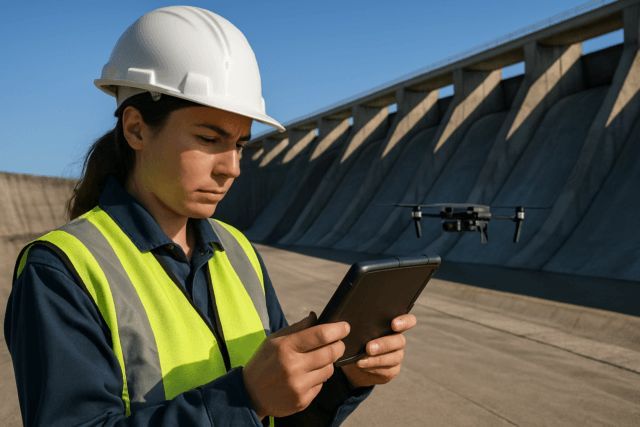

Imagine a world where the invisible tremors beneath our feet, the subtle shifts in earth that forewarn disaster, can be precisely mapped and understood without putting human lives at risk. This vision is rapidly becoming a reality thanks to the burgeoning field of drone-based seismic monitoring and hazard assessment. Unmanned Aerial Vehicles (UAVs), commonly known as drones, are transforming traditional geophysical exploration and environmental monitoring, offering unprecedented efficiency, safety, and accuracy in detecting and analyzing seismic activity.
The Evolution of Seismic Monitoring: From Boots on the Ground to Eyes in the Sky
Traditionally, seismic surveys have been labor-intensive and often hazardous, requiring extensive fieldwork, the deployment of large sensor arrays, and heavy equipment across vast and sometimes inaccessible terrains. This conventional approach often involves significant manpower to install, monitor, and retrieve sensor data, increasing both costs and safety risks.
The advent of drone technology has introduced a paradigm shift, enabling faster data acquisition, improved accuracy, and safer operations. Drones can cover larger areas in less time, reducing the need for extensive ground crews and translating into significant cost savings and faster project completion. By operating remotely, drones minimize human exposure to hazardous environments, enhancing safety and reducing the environmental footprint associated with large-scale ground surveys.
How Drones Facilitate Seismic Data Collection
Drones are equipped with sophisticated sensor integration and advanced flight control systems that enable them to collect high-resolution seismic data.
Advanced Sensor Integration and Payloads
Modern drones can be outfitted with a diverse array of sensors crucial for comprehensive seismic monitoring:
- Geophones: These vibration sensors are fundamental to seismic surveys, detecting ground motion caused by seismic waves. Some drone designs integrate geophones directly into their landing gear to ensure good ground coupling upon landing.
- Magnetometers: Used in geophysical exploration to detect variations in the Earth’s magnetic field, which can indicate subsurface geological structures.
- LiDAR (Light Detection and Ranging): Provides detailed topographical data, enabling the creation of 3D models of terrain and monitoring changes over time, critical for identifying potential hazards like landslides.
- Multi-spectral and Hyperspectral Cameras: These capture high-resolution imagery and detect variations in surface composition, aiding in geological data analysis and identifying subtle mineralogical differences.
- Accelerometers: Used for detecting seismic activity by continuously monitoring ground vibrations, providing real-time data crucial for timely responses.
Autonomous Deployment and Real-time Transmission
Drones offer automated deployment and recovery capabilities for seismic sensors. For instance, some systems involve drones carrying multiple wireless “dart nodes” that are dropped at specific points to record seismic signals. These sensors are designed to embed themselves in the ground and transmit data wirelessly, some even being biodegradable to eliminate the need for recovery teams. Real-time data transmission allows for immediate review and on-the-fly adjustments to survey parameters, enhancing data quality and decision-making.
Precision Flight Control
Accurate seismic surveys rely on drones maintaining stable flight paths, even in challenging environments. Advanced flight control systems ensure precise navigation using GPS and other positioning systems, automatic obstacle avoidance, and stable hovering for accurate sensor readings.
Applications in Hazard Assessment and Environmental Monitoring
The capabilities of drone-based seismic monitoring extend across various critical applications, significantly enhancing hazard assessment and environmental protection.
Earthquake Monitoring and Post-Disaster Assessment
Drones are invaluable for earthquake monitoring, especially after a disastrous event, by safely placing sensors close to epicenters without endangering human personnel. They provide high-resolution images and video to assess earthquake damage to infrastructure and buildings, offering a comprehensive overview that ground-level inspections cannot achieve. This remote assessment capability is particularly crucial for evaluating hard-to-access and hazardous parts of structures, like roofs and chimneys.
Landslide and Geological Hazard Detection
Continuous monitoring of geological conditions using drones equipped with thermal imaging and LiDAR can provide early warning systems for potential dangers such as landslides and subsidence. Drones can track ground movement, identify potential risks of rockfalls or unstable terrain before they become critical, and collect data on surface temperature, soil moisture, and vegetation health to detect signs of mudslide hazards.
Structural Health Monitoring of Linear Infrastructures
Drones are proving beneficial for the seismic monitoring and safety assessment of linear infrastructures like natural gas pipelines. Their ability to capture high-quality geospatial data independently of ground movement allows for monitoring pipelines before, during, or after seismic events, visibly outperforming other robotic counterparts. Computer vision algorithms aid in detecting features on tested objects through pattern recognition and matching.
Resource Exploration and Environmental Studies
Beyond hazard assessment, drone-based seismic surveys are critical in industries such as oil and gas exploration, mining, and broader environmental studies. They enable accurate subsurface mapping, helping geoscientists generate detailed models and identify potential resource deposits with precision.
Challenges and Limitations
Despite the transformative potential, drone-based seismic monitoring faces several challenges:
- Regulatory Restrictions: Government regulations regarding UAV operation can limit widespread adoption and application, particularly concerning flight ranges and specialized permits.
- Endurance and Power Management: Extensive survey missions require drones with long flight durations and robust power management, which remains a key area for development.
- Sensor Limitations: The lack of lightweight, low-cost, and portable geophysical sensors suitable for all UAV types can be an impediment.
- Ground Coupling: Achieving reliable coupling between geophones and the ground surface is crucial for quality data, and while spiked geophones on drones can penetrate soft soil, hard surfaces remain a challenge.
- Motion Separation: Acquiring seismic data from airborne sensors requires excellent knowledge of the drone’s motion to accurately separate sensor movement from actual ground motion.
The Future of Drone-Based Seismic Monitoring
The field of drone geophysics is rapidly evolving, driven by continuous technological advancements. The future promises even more sophisticated and widespread applications:
- AI and Machine Learning Integration: These technologies are being integrated into data processing systems to enhance the interpretation of seismic data, predict geological formations, and automate hazard detection.
- Multi-sensor Integration and Adaptive Sensing: The ability to combine various geophysical sensors and implement adaptive sensing capabilities will lead to more comprehensive and nuanced data collection.
- Extended Endurance and Hybrid Systems: Innovations in hybrid energy systems and power management will extend flight times and operational ranges, allowing for larger and more complex surveys.
- Real-time Processing and Decision Making: Advancements will enable real-time processing and rapid subsurface image delivery, allowing interpreters to adjust and optimize acquisition plans in the field.
- Autonomous Swarms: Development of autonomous robotic systems using swarms of UAVs equipped with seismic sensors could perform joint tasks and efficiently cover vast areas, enhancing the accuracy and resolution of subsurface imaging.
- Biodegradable Sensors: Further development of environmentally friendly, biodegradable sensors, like the “DARTs,” will minimize environmental impact and eliminate the need for sensor retrieval.
Drone-based seismic monitoring and hazard assessment represent a crucial leap forward in our ability to understand and respond to the Earth’s dynamic processes. As the technology matures, it will undoubtedly play an increasingly vital role in safeguarding communities, optimizing resource management, and deepening our scientific understanding of the planet.