Coral reefs, vital to marine biodiversity and human livelihoods, face unprecedented threats from climate change and local stressors. Understanding the genetic connectivity between these geographically separated populations is paramount for their resilience and recovery. Traditionally, monitoring such vast and complex ecosystems has been a Herculean task, often limited by scale, cost, and accessibility. However, a new generation of drone technology is rapidly transforming how scientists approach coral reef research, offering unprecedented precision and efficiency in monitoring the genetic connectivity of these critical marine systems.
The Critical Role of Genetic Connectivity in Coral Reef Health
Genetic connectivity refers to the exchange of genetic material between populations, primarily through the dispersal of coral larvae via ocean currents. This process is essential for maintaining the genetic diversity and resilience of marine populations. “Sink” reefs, for instance, maintain their genetic diversity by recruiting coral larvae from “source” reefs with diverse adult coral populations. This influx of new genetic material is crucial for a reef’s ability to adapt to environmental changes, recover from disturbances like bleaching events, and resist diseases. Without adequate connectivity, isolated reefs become more vulnerable to widespread disturbances, as they lack the genetic diversity to adapt or the external supply of recruits for recovery.
Understanding these connections is vital for effective conservation strategies, particularly in designing marine protected areas and implementing climate-smart restoration projects. The Royal Society’s Proceedings B highlights that genetic diversity is “the seed of ecological and evolutionary processes like niche partitioning and species diversification that lead to the complex community structure typical of coral reefs.”
Limitations of Traditional Coral Reef Monitoring
For decades, scientists have relied on labor-intensive and localized methods such as diver-based surveys to assess coral reef health. While providing accurate data at specific points, these methods are expensive, time-consuming, and often inconsistent in terms of spatial and temporal scale. The sheer size of many reef systems, such as the Great Barrier Reef (equivalent to the size of Japan or Italy), makes comprehensive diver-based surveys practically impossible. Furthermore, traditional techniques are limited in their ability to access deeper mesophotic coral ecosystems (MCEs), which are found at depths of 30 to 150 meters and are beyond recreational scuba diving limits.
These limitations create significant knowledge gaps, especially concerning broad-scale patterns of larval dispersal and the environmental factors influencing genetic exchange across entire reef systems.
Drone Technology as a Game Changer in Reef Monitoring
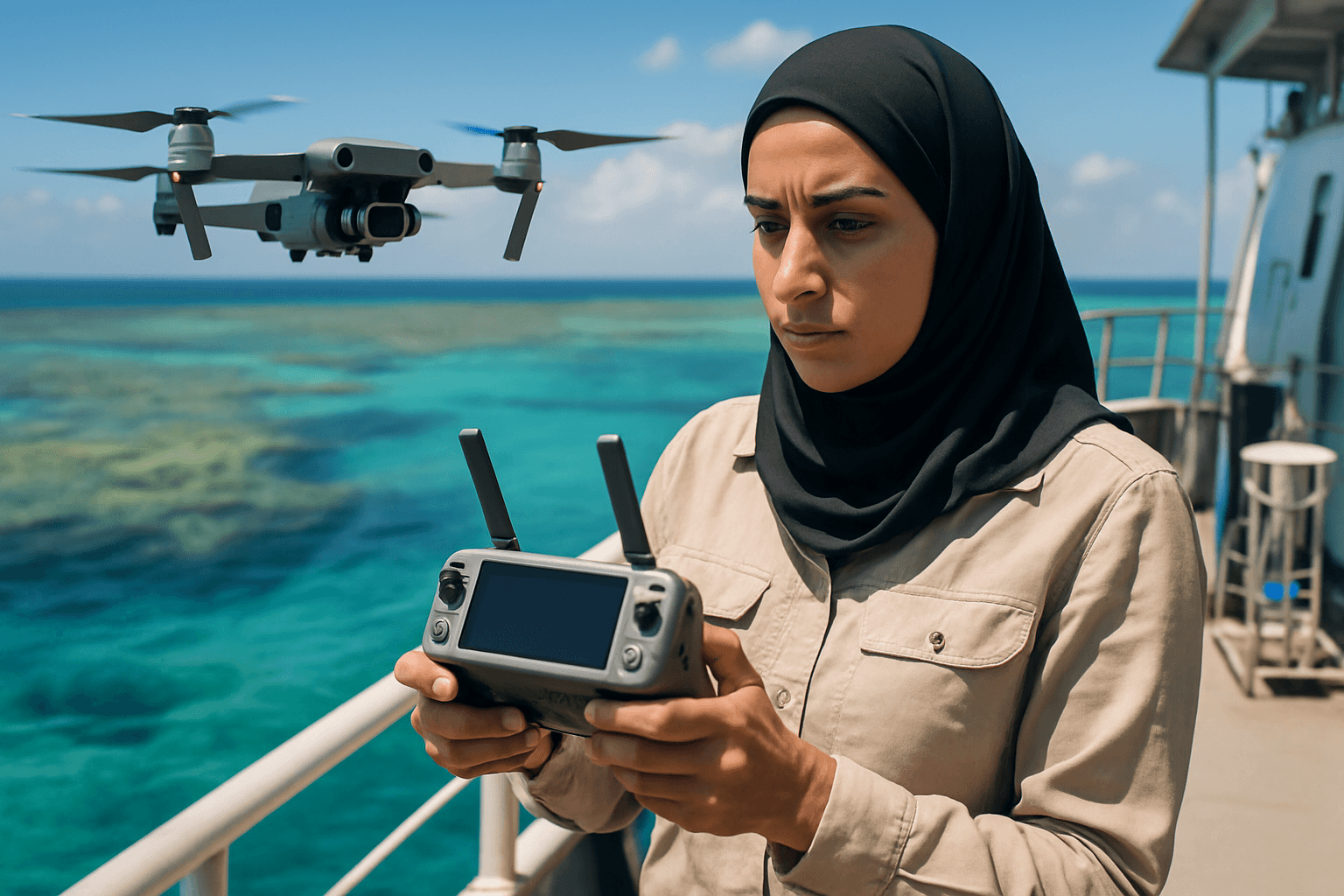
Unmanned aerial vehicles (UAVs) and remotely operated vehicles (ROVs), collectively known as drones, are revolutionizing marine research by overcoming many of the constraints of traditional monitoring. Equipped with high-resolution cameras, multispectral sensors, and advanced navigation systems, drones can collect vast amounts of data efficiently and with minimal disturbance to marine life.
Aerial Drones for Habitat Mapping and Environmental Characterization
Aerial drones offer a “bird’s eye view” that provides crucial context for understanding genetic connectivity. They are adept at:
- High-Resolution 3D Mapping: Drones create accurate 3D maps of reef structures, providing “unprecedented precision” and detail that can be a million times more precise than hand-measured efforts. These maps are vital for understanding reef health, identifying diverse habitat types, and tracking restoration progress. Researchers at Stanford have even developed “fluid lensing” techniques to overcome light distortion from waves, allowing for precise 3D mapping of subsurface structures from above.
- Multispectral and Hyperspectral Imaging: Drones equipped with multispectral cameras can capture both visible and infrared light signatures. This allows scientists to identify stressed coral colonies before visible signs appear and distinguish between different coral types and other benthic habitats like seagrass. Such detailed habitat classification can reveal potential dispersal corridors and barriers, informing models of larval flow.
- Environmental Parameter Monitoring: While aerial drones don’t directly measure underwater parameters, their imagery can be combined with other data sources to understand factors influencing coral health, such as water flow, wave action, and temperature, which are critical for preserving healthy reefs. These insights help predict which reefs might be more resilient to stressors and act as source populations for genetic replenishment.
Underwater Drones for Direct Sampling and Deeper Exploration
Submersible drones (ROVs and AUVs) are pushing the boundaries of what’s possible in underwater research:
- Environmental DNA (eDNA) Collection: In a groundbreaking development, scientists at the Okinawa Institute of Science and Technology (OIST) successfully used underwater drones to collect environmental DNA (eDNA) from mesophotic coral ecosystems. Corals constantly secrete mucus, providing ample eDNA for sampling, which allows researchers to identify the genera of corals present without direct observation or diving to extreme depths. This method offers a faster and easier way to conduct large-scale biodiversity assessments and track species distribution across varying depths, directly informing genetic studies.
- Precision Larval and Fragment Deployment: Underwater drones like the “LarvalBot” are specifically designed to distribute millions of coral larvae or hundreds of coral fragments across damaged reef sections with unprecedented accuracy. This precision deployment can help rebuild degraded “sink” reefs and enhance their ability to receive and incorporate new genetic material.
- Water Quality Monitoring: Submersible drones can collect real-time data on critical environmental indicators such as water temperature, salinity, pH levels, and dissolved oxygen concentrations. These parameters are crucial for understanding the environmental conditions that influence larval survival and settlement, thus indirectly impacting genetic connectivity.
Benefits and Future Prospects
The integration of drones into coral reef monitoring offers several significant benefits:
- Efficiency and Scale: Drones drastically reduce the time and effort required for surveys, allowing for more frequent and extensive monitoring of vast reef areas that are otherwise difficult or impossible to access.
- Cost-Effectiveness: Compared to traditional field surveys, drone-based remote sensing can be a more cost-effective approach for mapping and monitoring coral reef habitats.
- Enhanced Data Quality and Resolution: Drones provide high-resolution imagery and data, enabling detailed analysis of reef structure, coral health, and species distribution.
- Reduced Human Impact: Autonomous vehicles minimize human interference in sensitive marine environments, ensuring data collection is less disruptive.
The future of drone applications in monitoring coral reef genetic connectivity is promising, with ongoing advancements in artificial intelligence (AI) and swarm technology. AI algorithms are increasingly used to process vast amounts of drone imagery, identifying coral types, detecting bleaching events, and assessing reef health with greater accuracy and speed. The development of autonomous swarm capabilities, where multiple underwater drones work in coordination, promises to cover even larger areas and collect more comprehensive data simultaneously. These technological leaps will continue to refine our understanding of intricate connectivity patterns, empowering more targeted and effective conservation and restoration efforts for these invaluable ecosystems.